Remind the Commission of Fur Free Europe's demands: a ban on fur farming and the trade in fur on the EU internal market! Send email today →
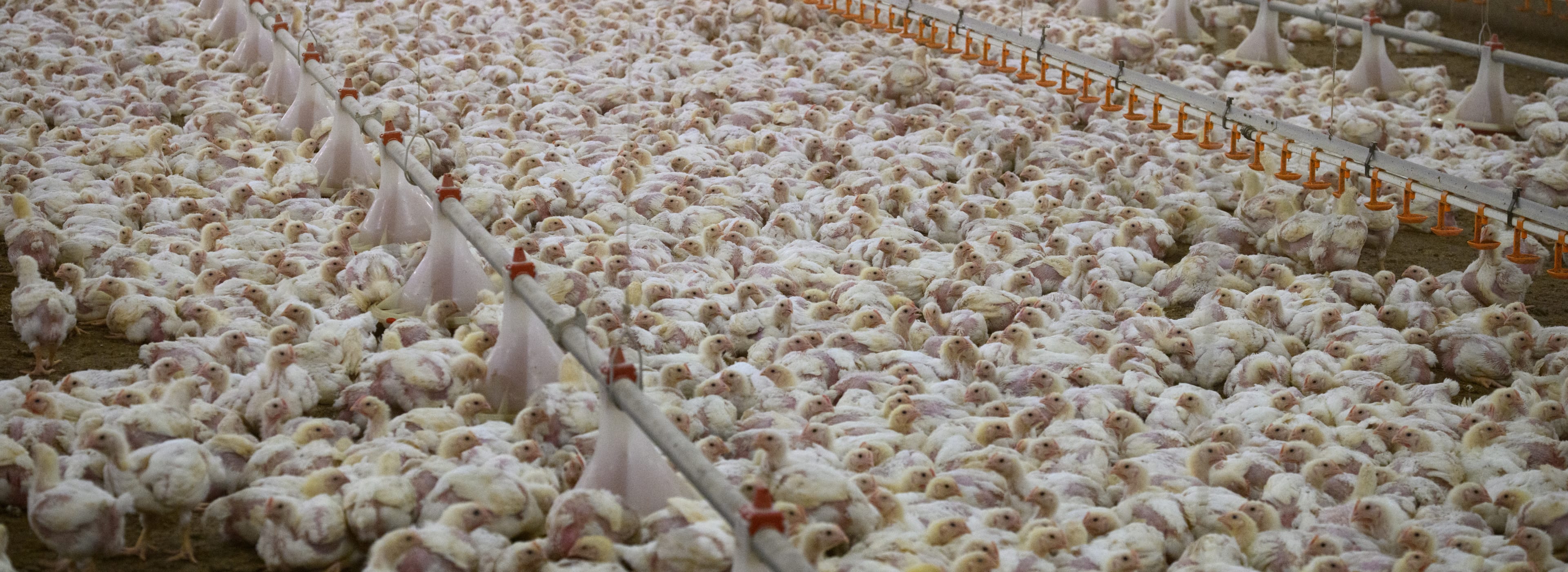
New investigation: The EU’s chicken industry is dominated by profit-driven large corporations
A new investigation reveals that the chicken meat industry is dominated by large companies, which controls the whole system. The individual factory farms have little bargaining power, despite carrying the financial risk. This stands in stark contrast with the ambitions of the EU’s Vision on the Future of Agriculture and Food – and increases animal suffering.
An investigation made by the group AGtivist reveals that 15 companies own almost 50% of the EU chicken industry market share, of which only one company is farmer-owned. In Sweden, the situation may be even worse, as the listed company Scandi Standard controls the majority of the market. The investigation highlights how individual chicken facilities are being locked into long-term contracts and incurring large debts to build factory farming systems that meet companies’ demands. They have little capacity to influence the conditions that influence the lives of the animals. For example, by switching to healthier breeds of chicken.
“The situation in the chicken industry is deeply unsustainable. A few companies dominate the chicken industry in the EU, and their business model is based on maximum production for maximum profit – all at the expense of the animals.”
– Benny Andersson, CEO of Project 1882
The conclusion is in sharp contrast to the European Commission’s (EC) Vision on Agriculture and Food and Strategy on Livestock, which highlight the importance of farmers’ agency. Where a small number of non-farmer-owned companies control market access and determine production specifications, the companies have the ultimate say on animal husbandry choices. This usually favours cost-effectiveness and maximum outputs, which mean Frankenchickens and high stocking density – over animal welfare. The findings follow a 2025 investigation showing that the EU is home to over 10,800 intensive chicken factory farms, with a steady increase over the past decade.
The chickens pay the price
This drive towards producing chicken meat as cheaply and quickly as possible has serious consequences for the animals. Around 90% of chickens in the EU are raised in intensive systems, while it is more like 99 % in Sweden. They are kept at high stocking densities and are bred to grow so fast that it hurts them. Frankenchickens often suffer from serious welfare problems, including lameness, heart failure, metabolic disorders, and heat stress.
The investigation also reveals the external costs linked with the chicken industry consolidation, including:
- Poor working conditions amid pressure to produce chicken meat as cheaply, and as quickly as possible.
- Public health costs induced by high levels of foodborne illnesses and antibiotic resistant superbugs.
- Public money used to bail out the industry during ever-growing disease outbreaks.
The latter has been the Swedish chicken industry’s main lobbying effort, which proved successful in 2026 after the government decided to give chicken factory farms state aid in the event of a salmonella outbreak.
“As long as the large corporations behind the chicken industry are given free rein, the situation will continue to be unsustainable for both people and animals. If the EU is serious about moving toward a sustainable agricultural future, it must now take responsibility for a systemic change. A first and absolutely essential step is to ban Frankenchickens.”
– Benny Andersson
An unsure future
Chicken welfare is part of the upcoming EU animal welfare legislation’s modernisation, but the European Commission (EC) risks to only adress the banning of cages and no other important welfare issues. Eurogroup for Animals, of which Project 1882 is a part, therefore calls on the EC to revise the EU Broiler Directive to ensure the well-being of chickens, as the sentient beings they are, by:
- reducing stocking densities,
- favouring slower-growing and higher welfare breeds,
- providing natural light and enrichment.
Read more:
Frankenchickens are bred to suffer
Sign the petition to ban Frankenchickens in EU.
